
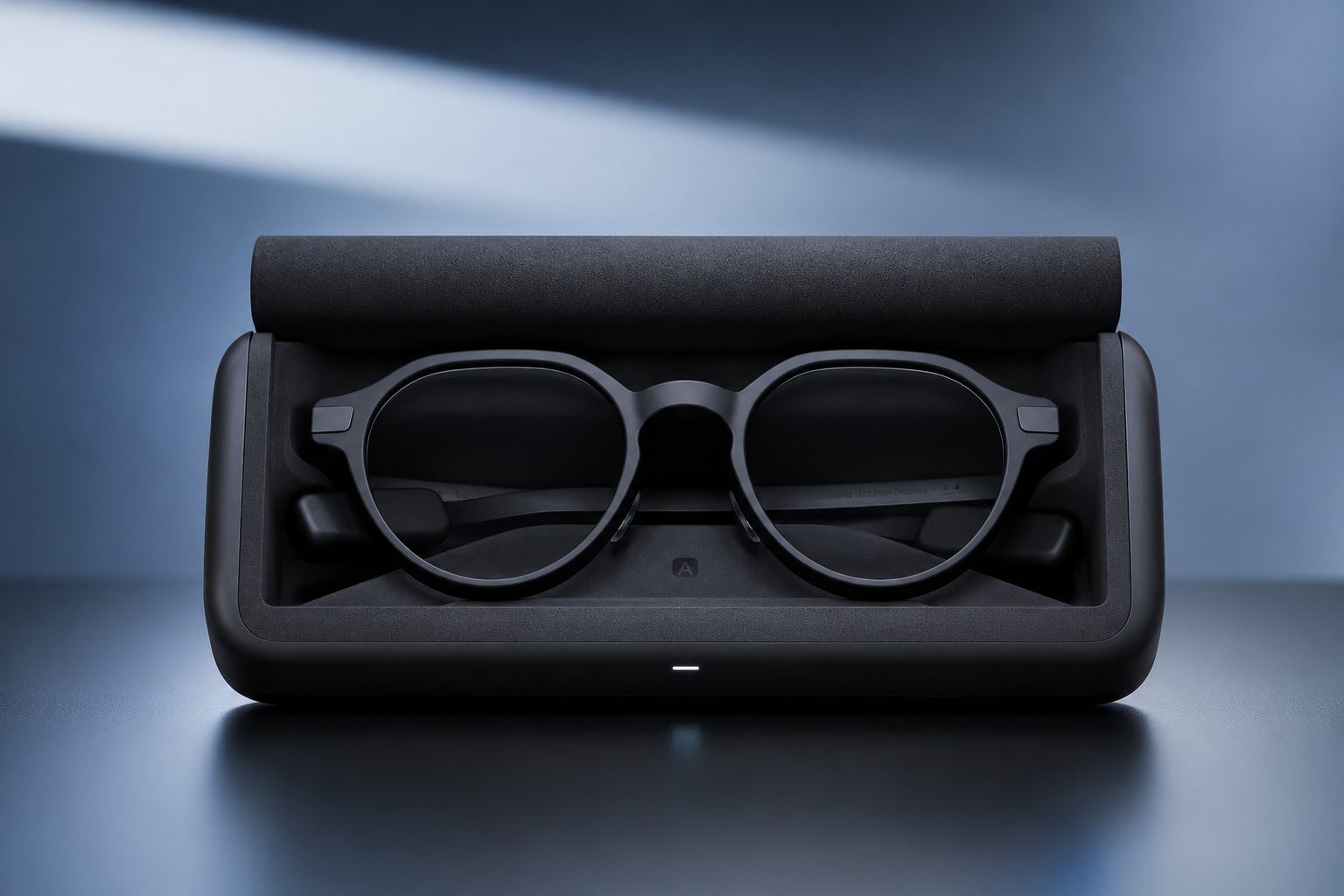
While most smart glasses manufacturers are racing to add better cameras and AI-powered recording features, startup Even Realities is taking a very different approach. Its latest G2 smart glasses completely eliminate cameras and speakers, focusing instead on productivity, privacy, and everyday usability.
The company believes that the future of smart glasses is not about recording everything around you, but about helping users work more efficiently without making people nearby feel uncomfortable.
What’s New?
Unlike products such as Meta’s Ray-Ban smart glasses, the Even Realities G2 does not include a camera for taking photos or recording videos. Instead, it features a discreet monochrome heads-up display that projects text-based information directly into the user’s field of view.
The glasses are designed primarily for professionals who frequently attend meetings, give presentations, travel internationally, or need quick access to information without constantly checking their smartphones. Features such as real-time translation, navigation, notifications, and note-taking are placed at the center of the experience.
Key Features
- Camera-free design for enhanced privacy
- No built-in speakers, creating a more discreet wearable experience
- Monochrome heads-up display for text and essential information
- Real-time language translation
- Navigation assistance
- Meeting notes and productivity tools
- Smartphone notification support
- Lightweight design suitable for all-day wear
Why it Matters?
The smart glasses market has increasingly become associated with privacy concerns. Devices equipped with cameras often raise questions about whether people are being recorded without their knowledge.
Even Realities is betting that many consumers, especially professionals, care more about usefulness than continuous recording.
This strategy reflects a broader shift in wearable technology. Rather than trying to replace smartphones with camera-heavy devices, some companies are beginning to position smart glasses as personal productivity assistants that help users stay informed while remaining socially acceptable in public spaces. Recent debates around camera-enabled wearables and recording indicators have further highlighted why privacy-first alternatives are attracting attention.
Availability
Even Realities is positioning the G2 as a premium productivity device rather than a consumer entertainment gadget. The company recently raised $150 million in funding, reaching a $1 billion valuation, demonstrating growing investor confidence in its camera-free vision for wearable computing.
Expert Opinion
The launch of the G2 suggests that the smart glasses industry may be entering a new phase.
For years, companies competed by adding more cameras, better video quality, and increasingly advanced AI features. However, those innovations have also intensified concerns over surveillance and social acceptance.
Even Realities is challenging that direction by asking a different question:
What if smart glasses become tools for thinking and working instead of tools for recording?
If professionals embrace this philosophy, the market could gradually split into two categories:
Creator-focused smart glasses built around cameras, content creation, and social media.
Productivity-focused smart glasses designed to improve work, communication, and personal efficiency while minimizing privacy concerns.
This differentiation could become one of the defining trends in the next generation of wearable AI devices.
Final Thoughts
Even Realities is not trying to build the most feature-packed smart glasses. Instead, it is attempting to solve one of the industry’s biggest trust issues: privacy.
Whether this strategy succeeds remains to be seen, but it introduces an important alternative at a time when AI wearables are becoming more powerful and more controversial.
For users who value focus, productivity, and discretion over photography and social sharing, camera-free smart glasses could represent a compelling new direction for wearable technology.